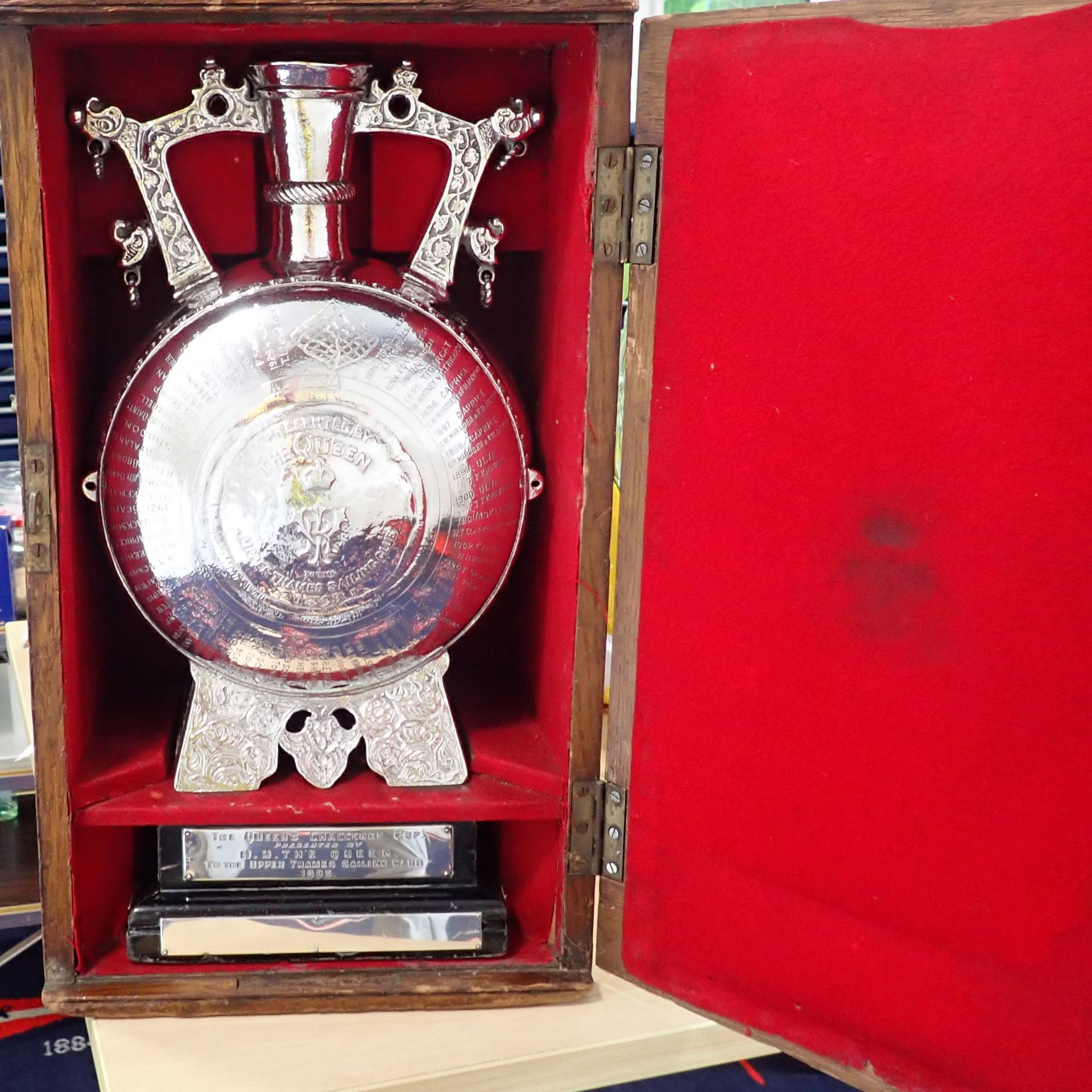
On Wednesday 21st June 1893, the start as 1.30 pm, and the course as nine miles on the Bourne End reach. There were ten competing boats, representing six clubs: Thames Sailing Club, Thames Valley Sailing Club, Upper Thames Sailing Club, Tamesis, Thames United and Oxford University Sailing Club. Racing took place in strong and gusty north-westerly winds. Conditions were challenging from the outset—Ruby ran aground but managed to get free and continue. All boats began the race with reefs in their sails, though some crews shook them out during a brief lull in the wind. The rough weather took its toll: Folly became half-filled with water and was eventually forced to retire. Despite the conditions, the race was won by T. F. Knowles sailing Mona, a boat with a 0.85 rating representing Thames Valley Sailing Club. Second place went to Walter Stewart's Challenge, a 1.1-rated entry from Oxford University Sailing Club.
This seems to have been a fairly serious sailing day rather than a genteel Victorian procession around the river. The morning was described as bright with a strong sailing breeze. By shortly after noon the crews were already examining their equipment and, interestingly, watching the barometer. The weather looked sufficiently threatening that they expected they might have to reef at the last moment. That tells us something about the sophistication of the sailors. They were not merely looking at the clouds; they were actively using pressure changes to judge what might happen during the race. Later UTSC research describes the wind more specifically as a strong and gusty north-westerly and says the boats started reefed, with some crews subsequently shaking their reefs out during a temporary lull.
The 1894 writer emphasises just how narrow the Thames was for what was about to happen.
This was a flying start rather than ten boats sitting stationary on a starting line.
So imagine ten large, extremely lightly built racing boats, carrying enormous sail areas by the standards of their hulls, all sailing around the start area trying to gain the best position before 1.30.
Yet the contemporary observer was impressed that they managed it:
“without a foul or a protest”
and described the handling as admirable.
For anyone who has watched a modern Rater start at Bourne End, that is perhaps one of the most evocative details in the entire account.
Ten boats were fighting for position on essentially the same stretch of river we race on today.
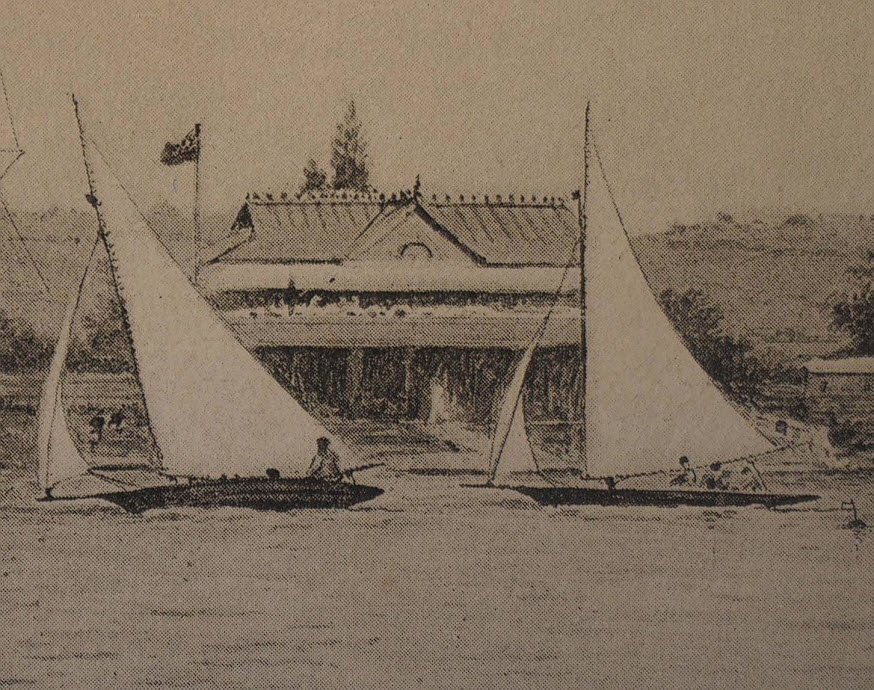
Adapted from a drawing in Yachts and Yachting of the first Queens Cup Race
Another wonderfully revealing detail concerns what the reporter calls “shifting ballast.”
He describes crew members stretching themselves out to windward in what he regarded as almost acrobatic positions. Boats were also taking water aboard and crews were bailing it out.
So the familiar Rater technique of using human weight aggressively to keep the boat upright was already conspicuous in 1893.
Correspondence written the following year to American yacht designer Nathanael Herreshoff gives us additional insight into the Raters of this period. It explains that a prospective 0.8–0.9 rater would gain the greatest advantage from a crew of three to windward, that Queen's Cup boats had to rate at least 0.8, and that the Bourne End courses were normally six to nine miles, generally involving running and turning back to windward. It also stresses that boats had to be extremely quick in stays because parts of the river were so narrow.
That document dates from 1894, so I would not turn it into an absolute statement that every boat in the inaugural race necessarily carried exactly three people. But it is very good evidence for how these boats were being sailed immediately afterwards.
Once they were away, the early leader was the Oxford University boat Challenge.
She is described initially as a 1-rater, although elsewhere in the same account she is given a rating of 1.1. I suspect the first figure is being used descriptively or rounded; the later UTSC history also gives Challenge as 1.1.
Challenge led for the first three or four rounds.
Immediately behind her was Mona, rating 0.85.
And the third boat singled out by the reporter was the 1.0-rater Mirage, which was said to be going well and looking particularly handsome.
This gives us a provisional early race order:
Challenge → Mona → Mirage
but it does not prove that Mirage eventually finished third.
That is tantalising because we know Kitten finished fourth. It would be tempting to fill the missing third place with Mirage, but there is not yet enough evidence to do that responsibly.
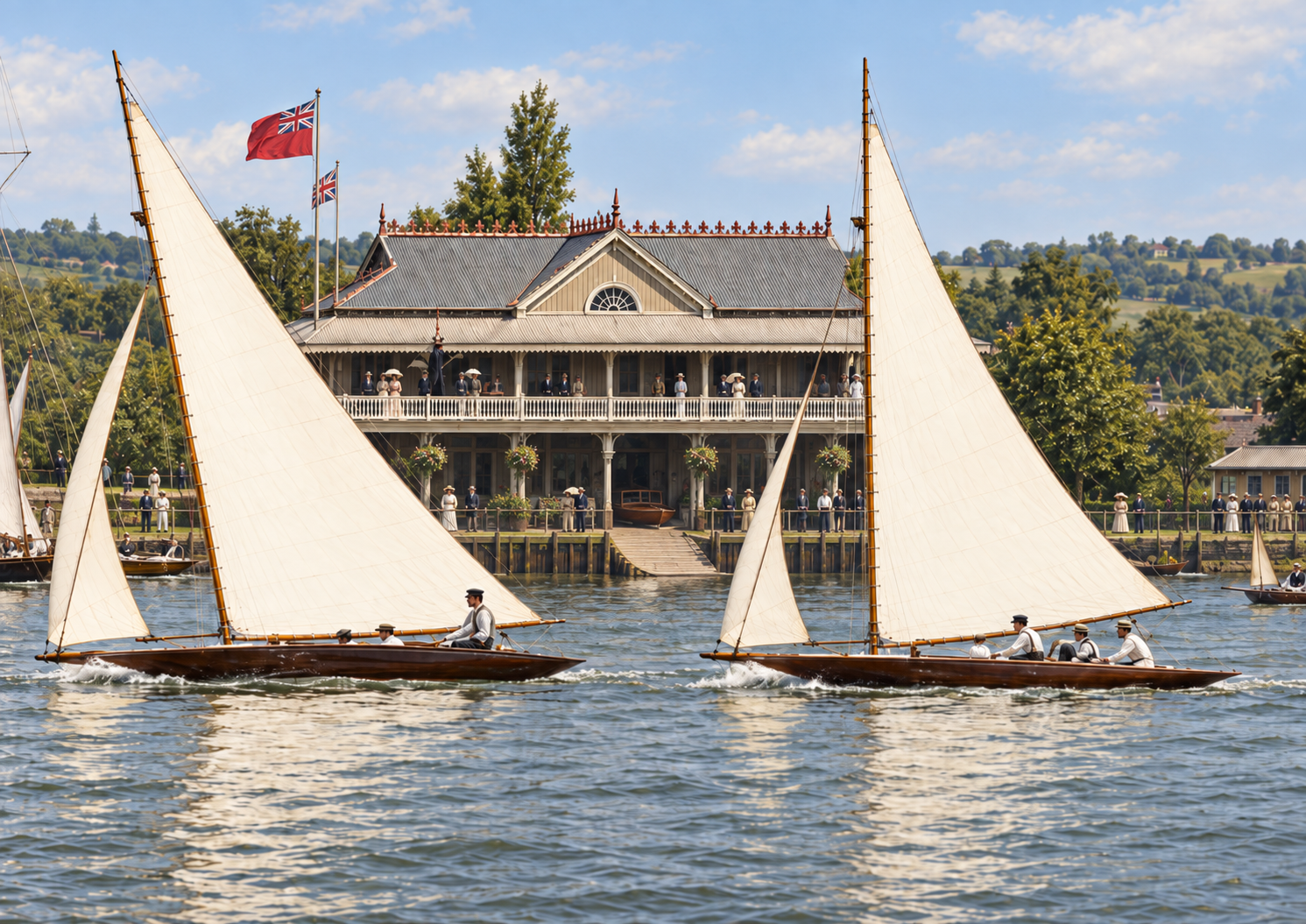
A colourised photograph from a race of this era. The A-Raters are heading upstream from the Spade Oak.
The later UTSC historical research adds a dramatic incident that isn't mentioned in the 1894 Yachting passage.
Ruby ran aground.
She apparently managed to get herself free and continued racing.
That is wonderfully characteristic of Thames Rater sailing. At Bourne End, gaining just a few feet of advantageous water can matter, but get too ambitious towards the bank and the riverbed becomes part of the race.
Ruby herself is a particularly interesting early boat. She predates what we now think of as the mature A-Rater and had undergone significant development by this period. I would like eventually to establish who owned and sailed Ruby that afternoon, because that should be recoverable from contemporary club or newspaper records.
The weather seems to have become increasingly difficult.
The same later account says that Folly became half-full of water and eventually retired.
Combined with the contemporary report's references to crews bailing, reefing and hard gusts, this strongly suggests conditions were genuinely testing these extremely lightly constructed craft.
It also makes Mona's later manoeuvre particularly significant.
At some stage after Challenge's initial three or four rounds in front, Mona took the lead.
Unfortunately the contemporary account doesn't tell us exactly when or how.
We therefore cannot yet say whether Knowles passed Stewart through better boat speed, a wind shift, a superior rounding, an error by Challenge or some other tactical event.
But by the last round but one, Mona was definitely leading.
Then she was hit by a particularly hard gust.
A remarkable piece of seamanship
The crew of Mona decided to reef during the race.
The writer says they did so principally to make sure of saving the mast and was clearly extremely impressed by how efficiently the manoeuvre was carried out.
That is worth thinking about.
They did not have today's carbon spars, modern sail controls or modern reefing systems. They were racing a highly developed Victorian river yacht under enormous sail pressure and apparently managed to reduce sail while still protecting their lead.
The reporter considered the operation sufficiently noteworthy to record it a year later.
It also tells us that finishing the race with the mast still standing wasn't something they could take entirely for granted.
The contemporary account becomes particularly exciting here.
Mona and Challenge approached the finish neck-and-neck, but on different gybes.
Challenge was carrying her small spinnaker on the port hand.
Mona was on starboard.
The rules required the spinnaker to be no larger than the jib.
Picture the scene: after roughly nine miles of river racing, repeated turns and several rounds of the course, a strong gusty day, reefing, bailing and at least one grounding, the two principal boats were still almost together as they approached the finish.
This wasn't a processional victory.
It was a genuine match right to the end.
The 1894 author simply calls it:
“capital racing.”
And Mona won.
The winner was Thomas Foster Knowles, sailing Mona, rating 0.85, for Thames Valley Sailing Club.
Knowles is beginning to emerge as quite an interesting character in his own right.
He was an active Thames Valley Sailing Club member and is recorded as racing both Mona and Ulva; he later became Rear-Admiral of the club. A biographical account also refers to a South Bucks Standard interview with him in 1893 following his victory at Bourne End.
That is a very promising lead.
If we can find that original South Bucks Standard report, it may contain exactly what we currently lack:
the entry list, finishing order, winning margin and perhaps the names of crews.
Knowles would subsequently become one of the major names in early Rater competition, but on this afternoon he became something more specific:
the first person ever to win Queen Victoria's Queen's Cup.
Second was Walter Stewart's Challenge, representing Oxford University Sailing Club, rating 1.1.
Stewart therefore deserves more attention than he has generally received in the modern telling of the story.
Challenge wasn't simply runner-up. She appears to have been the dominant boat through the early part of the race and was still almost alongside Mona at the finish.
Oxford University's involvement is itself notable. The 1894 Model Yachtsman and Canoeist shows Oxford University Sailing Club as an active organisation in this period, with its own programme of racing.
I have not yet found Walter Stewart's full crew for the Queen's Cup race.
This is another interesting discovery.
The 1894 account explicitly states that Kitten finished fourth.
It says that the Upper Thames secretary had lent his steam launch Leopard to Captain Bell of the Thames Conservancy, while: the Secretary and the Commodore sailed Kitten.
We know the Commodore: Colonel FitzRoy Clayton. Clayton was one of the important figures in early UTSC history. The contemporary Yachting account actually singles him out as a highly experienced practical yachtsman.
So we can put:
Kitten — crew: Colonel FitzRoy Clayton + UTSC Secretary — 4th.
Who was the secretary?
T
here is a very strong candidate.
Correspondence from the following year identifies Charles Tyrwhitt Ricardo, of Ray Mead, Maidenhead, as:
Secretary of Upper Thames Sailing Club.
That correspondence is particularly credible because it was written by Robert Taylor Pritchett—the marine artist involved in Yachting—in connection with commissioning a one-rater from the famous Herreshoff yard.
Consequently I think we can cautiously reconstruct Kitten as:
Kitten — sailed by Colonel FitzRoy Clayton and probably Charles Tyrwhitt Ricardo — fourth.
I say probably because I have not yet located a document explicitly saying “Ricardo was secretary on 21 June 1893”.
We know he held the office in 1894, but a one-year difference matters when doing proper provenance work.
Nor do we know which of Clayton and Ricardo was actually on the tiller.
There was also some proper race organisation on the water. The UTSC Secretary normally owned the steam launch Leopard, but for the Queen's Cup he handed her over to Captain Bell of the Thames Conservancy. Presumably Leopard was being used in connection with race management, safety or observing the contest, although the source doesn't specify her precise function. I'd like to identify Captain Bell fully. A Thames Conservancy personnel list from 1893 may allow that.
We know from the 1894 account that the racing took place on a nine-mile course on the Bourne End reach.
The following year's Herreshoff correspondence says Bourne End Queen's Cup-type courses were generally:
six to nine miles, involving a run and a turn to windward.
The account's statement that Challenge led for “three or four rounds” and that Mona was leading in the “last round but one” tells us that the nine miles were accumulated by multiple laps or rounds, rather than one nine-mile passage along the river.
That makes geographical sense: there simply isn't an uninterrupted nine-mile racing reach at Bourne End.
What I have not yet established are the exact 1893 turning marks.
That could probably be recovered from the sailing instructions or a contemporary newspaper report.
This is the most defensible reconstruction:
1st — Mona
Rating: 0.85
Club: Thames Valley Sailing Club
Owner/helm: Thomas Foster Knowles
Notes: stayed close to Challenge during early laps; subsequently led; took a reef in a hard gust on the penultimate round; won after a very close final battle.
2nd — Challenge
Rating: 1.1
Club: Oxford University Sailing Club
Owner/helm: Walter Stewart
Notes: led for first three or four rounds; challenged Mona right to finish; carrying small spinnaker approaching finish.
3rd — Unknown
This is the most frustrating missing result.
Mirage (1.0) was prominent enough for the contemporary writer to single her out, but that does not prove she was third.
4th — Kitten
Crew/sailors: Colonel FitzRoy Clayton and the UTSC Secretary; probably Charles Tyrwhitt Ricardo.
Club: presumably Upper Thames SC.
Exact rating: not yet established.
Other known competitors
Mirage — 1.0: final result unknown.
Ruby: later account says grounded, freed herself and continued.
Folly: later account says half-filled with water and retired.
Four competitors still unidentified
And therefore the first major archival target is no longer vague. We know exactly what we're looking for:
a ten-boat entry/result list for the Upper Thames Sailing Clubs Queen's Challenge Cup, Bourne End, June 1893.
If we strip away anything speculative, the afternoon probably looked something like this.
At midday on 21 June, crews gathered around the Bourne End clubhouse with the pressure falling or otherwise causing sufficient concern that sailors were checking the barometer and considering reefs.
By 1.30 ten boats were circulating around the constrained starting area.
The gun or starting signal released them into a flying start.
Challenge came through the opening exchanges best and established herself as the early leader. Mona stayed close enough not to let Stewart escape. Mirage remained competitive behind them.
The boats repeatedly raced up and down the reach, with crews using their own bodies as movable ballast, stretched out over the windward sides. Spray and water came aboard and had to be bailed.
The wind appears to have been sufficiently variable that sail area was a constant decision.
If the later account is correctly associated with this race, Ruby made an expensive tactical excursion into the shallows and grounded before escaping, while Folly took so much water aboard that she eventually retired.
At some point after the third or fourth round Knowles got Mona ahead of Challenge.
On the penultimate round a hard gust struck Mona.
Rather than gambling the mast for outright speed, her crew reefed. Remarkably, they accomplished this efficiently enough that Challenge couldn't simply sail away from them.
Then on the last stages the two boats converged again.
Challenge was running with her little spinnaker deployed to port.
Mona approached on the opposite gybe.
They were effectively neck-and-neck after nine miles of racing.
And when it was finally decided, Thomas Foster Knowles and Mona had won the first race ever sailed for Queen Victoria's new Challenge Cup.
That is a much better story than simply:
1893 — Queen's Cup won by Mona.