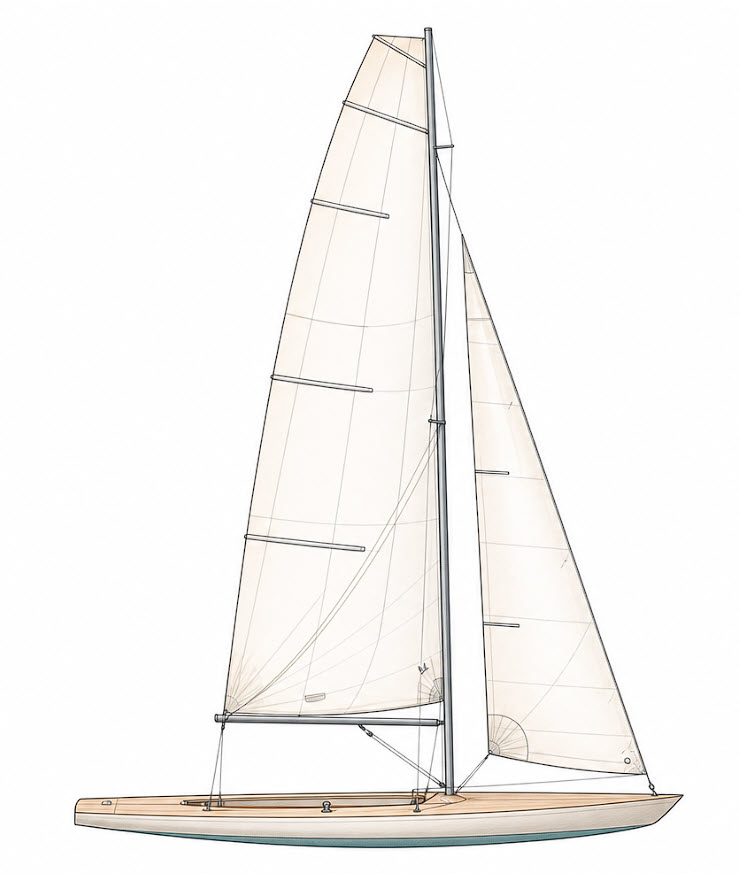
A Thames A-Rater is a very unusual, highly specialised three-person racing sailing boat developed specifically for racing on the River Thames. It is one of the oldest continuously raced sailing classes in Britain, with its origins in the late Victorian period.
What makes an A-Rater immediately distinctive is the combination of a long, very light hull and an enormous, tall sail plan. A typical boat is around 26 ft (7.9 m) long overall but has only about a 16 ft waterline, while modern carbon masts are roughly 43 ft tall. Traditional wooden boats carry about 385 sq ft of sail, while newer boats generally carry around 350 sq ft. They are normally sailed by a crew of three.
The name comes from an old yacht-measurement system introduced in 1887.
A yacht's rating was calculated approximately as:
Rating = sail area x waterline length / 6000
Designers were given remarkably few other restrictions, so they quickly discovered that they could build boats with short measured waterlines, very long overhangs and huge sail areas. In 1900, boats rating between 0.75 and 1.0, sailed by crews of three, were formally classed as A-Raters; smaller two-person boats became B-Raters.
That explains the extraordinary shape. At rest the boat has a comparatively short waterline, but as it heels and accelerates, more of those long overhangs become immersed, effectively giving it a much longer working hull.
They are essentially Victorian racing machines
The easiest way to think of one is as a Victorian-era racing formula that has continued developing for more than a century.
The earliest boats used lug rigs, followed by gunter rigs and eventually the Bermudan rigs seen today. The surviving fleet now mixes extraordinarily old wooden hulls with GRP and carbon-fibre construction, carbon masts and modern sailcloth.
The oldest surviving boat, Ulva, dates from 1898. During the 1980s a mould was taken from Ulva so that new GRP A-Raters could be built without abandoning the essential hull form. My A-Rater - Champagne is based on the Ulva hull shape.
River sailing is very different from open-water sailing. Winds are interrupted by trees, buildings and bends in the river. Gusts can appear suddenly and disappear almost immediately.
The A-Rater evolved specifically for those conditions:
When the breeze arrives, however, all that sail makes an A-Rater extremely lively. The A-Rater Association describes them as high-performance sailing dinghies designed for river racing, combining historic hull concepts with modern carbon-fibre technology.
Calling one a “dinghy” gives a slightly misleading impression. It isn't much like a Laser, Wayfarer or RS Toura.
A Rater is closer to a small racing yacht without a keel, optimised almost ruthlessly for one particular environment.
They are also unusual because the class is not really a strict one-design class. Historically the measurement rule allowed designers considerable freedom, so individual boats differ. Even boats originating from the same mould are not necessarily identical. Modern class rules preserve that heritage while preventing completely unrelated hull designs from entering the class.